You add water, massage, and the oil on your face is meant to turn milky and rinse away clean. Most of the time it does. Sometimes it stays part-oily, or seems to “break” instead, and you wonder whether the product is faulty. Almost always, it isn’t: emulsifying is kitchen-level chemistry, and it goes wrong for a handful of predictable, fixable reasons.
What’s happening on your face
Oil and water don’t mix on their own; left alone, they separate. An emulsifier is a molecule with one end that bonds to oil and one that bonds to water, so it holds the two together.
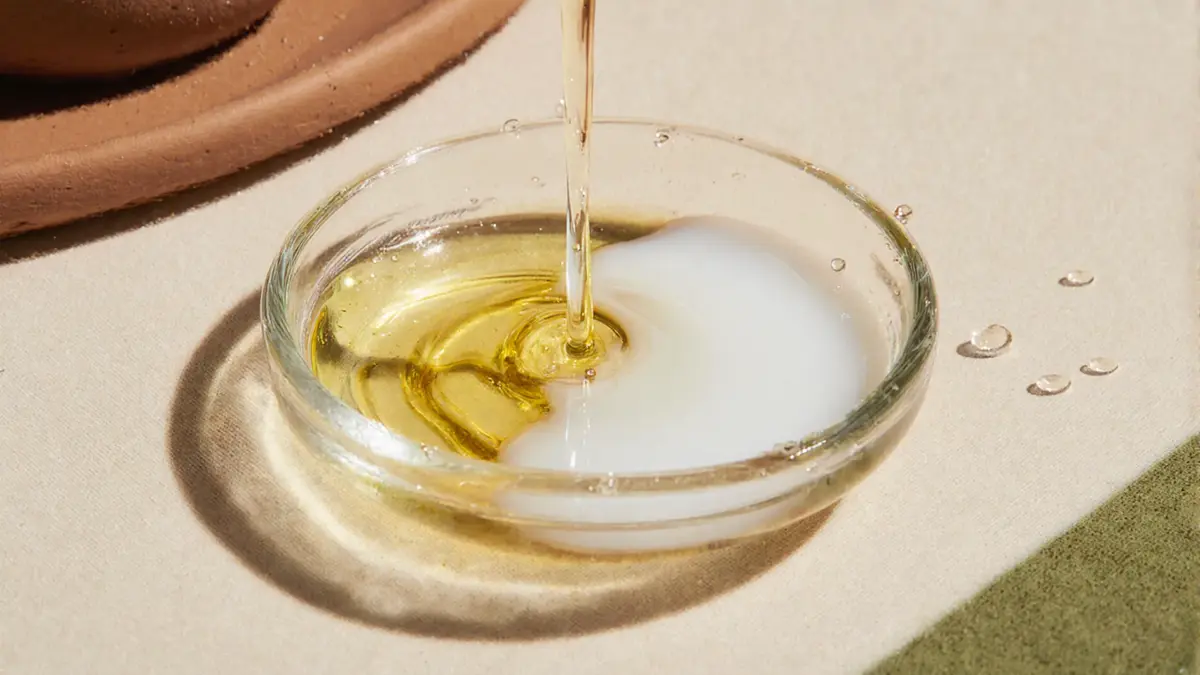
In an oil-to-milk cleanser, sugar-derived emulsifiers sit in the oil phase doing nothing until water arrives. In our own Oil-to-Milk Cleanser those are sucrose laurate and sucrose palmitate. Add water, massage enough to spread it evenly, and they grab both liquids at once, pulling the mix into that milky texture.
There’s no separate activation step and no timer. It’s a physical reaction that depends on getting the ratio and the mixing right, and that’s where most emulsifying problems come from.
Why your cleansing oil isn’t turning milky
- Wet hands or a wet face before you start. The most common cause. Water already on your skin makes the emulsifiers react unevenly to trace amounts, instead of starting from a proper dry oil phase. Dry off fully before the first pump.
- Too much water, too fast. A big splash can swamp the ratio before it’s mixed, leaving pockets of oil that never emulsify.
- Not massaging long enough. Thirty to sixty seconds before water, and more massage as you add it, is what makes the shift happen cleanly.
- Too little product, to make the bottle last. Less oil means less capacity to emulsify the water you add.
- Cold water. Emulsifying runs more smoothly with lukewarm water; very cold water can make it feel sluggish.
How to emulsify a cleansing oil properly
Start with a completely dry face and dry hands. That prevents most of the problems above. Pump onto dry skin and massage for 30 to 60 seconds in slow circles, letting the oil work on makeup, SPF and sebum before any water goes near it.
Add a small amount of lukewarm water, a splash rather than a handful, and keep massaging. Feel for the shift from oil to milk under your fingers. Then rinse thoroughly, paying attention to the hairline and jaw.
A fully emulsified rinse looks evenly milky-white: no oily streaks, no clear or yellowish patches. It rinses away completely and leaves skin clean rather than filmy.
Still seeing clear oil patches, or does your skin feel coated? Go back to the list. It’s usually a ratio or timing fix, not a different product. If you’ve tried all of it, slow down, dry your face fully and try again with a full pump and a gradual splash, not a rinse under the tap. Scrubbing harder won’t do the chemistry’s job for it.
Can you make one at home?
A plain DIY cleansing oil, a carrier oil and maybe a couple of essential oils, handles the “oil dissolves oil” part fine. Turning that into an oil-to-milk formula is a harder project.
Shake oil and water together without an emulsifier and you get tiny droplets of one spread through the other. With nothing holding them, they separate back into two layers within minutes. It’s why salad dressing needs a fresh shake every time. You’d need an emulsifier, something like lecithin or a polysorbate, and the right ratio, which home recipes often get wrong.
The bigger problem isn’t the chemistry. Once water is in a formula, microbes can grow in it. Commercially, a proper preservative system, dosed and tested for that specific formula, keeps that in check. An oil-only cleanser has no water, so it doesn’t need one. A DIY oil-to-milk formula does, and getting that right at home is harder than finding the emulsifier.
Quick questions
What does “emulsify” mean in skin care?
Combining oil and water into one stable mixture using an emulsifier. In a cleansing oil, it’s the moment the formula turns from oily to milky as you add water.
Why isn’t my cleansing oil turning milky?
Almost always technique, not a faulty product: wet skin before you start, water added too fast, too little massage, or too little product. See the list above.
Can I make my own emulsifying cleansing oil?
You can, but it’s harder than a plain DIY oil cleanser. You need an emulsifier, the right ratio and, because there’s now water in the formula, a proper preservative system to keep it safe on your face over time.
Once the technique is down, it takes about ninety seconds most evenings. To see how this format compares with a plain cleansing oil or milk, read oil cleanser, milk cleanser, or both, or our three-way comparison with micellar water. There’s also when a second cleanse makes sense, and, if your skin runs oily or combination, how the format performs on oily skin.