Yes. You can double cleanse with an oil-to-milk cleanser, and you don’t need a second product; the same bottle handles both passes. The more useful answer is that most evenings you probably don’t need to. Working out which evenings are the exception does more for your skin than a permanent extra step you resent by Wednesday.
Our guide to oil cleanser, milk cleanser, or both covers the chemistry behind these formats. This piece is about what to do at the sink.
What double cleansing is, and what an oil-to-milk format changes
Double cleansing means washing your face twice, in a deliberate order, each pass doing a different job. The first cleanse is oil-based. Oil dissolves oil, so it breaks down what water can’t shift on its own: makeup, sunscreen, sebum with a day’s grime in it.
The second cleanse is water-based, and its job is smaller than the internet usually suggests. It clears what the first pass loosened but didn’t carry away, so skin ends up evenly clean rather than patchily so. It’s a sequence, not “cleanse harder”, and it was never designed as a nightly universal. It became one mostly because it’s easy to sell as one.
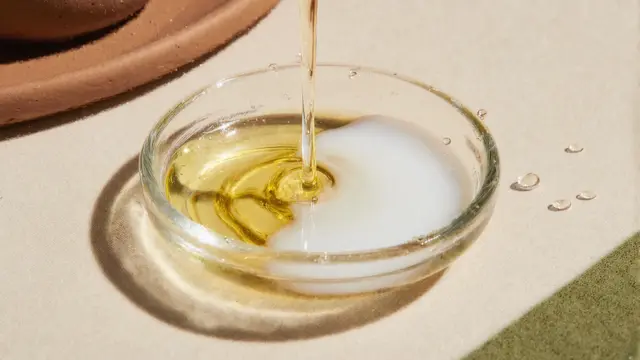
An oil-to-milk cleanser goes on as an oil and turns milky the moment it meets water, so one product covers both chemistries in a single pass. That’s the whole reason the format exists.
What it doesn’t give you is the second pass itself, because the value of a second cleanse was never mainly chemical. It’s mechanical. A fresh application onto skin that’s no longer coated in the day lets you be thorough at the hairline, around the nostrils and along the jaw, where a first pass almost always runs thin. If you want that second pass, use the same product twice rather than chasing it with a foaming wash that undoes the gentleness you were after.
When a second cleanse is worth it, and when it isn’t
A second pass earns its place on evenings with long-wear or heavy makeup, high-factor SPF reapplied through the day, or a properly grimy day: a long commute, heat, a lot of sweat, a smoky room, a festival. The clearest signal is the towel test. If your towel or a cotton pad still picks up colour after you’ve cleansed and dried, trust that over any rule.
Most evenings aren’t that. If you wore a normal amount of makeup, or none, plus a single morning SPF application, one thorough pass with thirty seconds of proper massage does far more than two rushed rounds.
Over-cleansing has a cost nobody advertises. Skin that feels tight, looks slightly flat, or starts producing more oil by mid-afternoon is often just being washed more than it needs. Doubling up also uses roughly twice the product: a fine trade on the evenings that need it, a waste on the ones that don’t.
How to double cleanse, step by step
The method matters more than the product count, and both passes follow the same sequence.
- Start with dry hands and a dry face. Water on your skin or hands starts the emulsification early, and the oil phase never gets a proper chance to grip the makeup and SPF.
- Pump onto dry skin and massage for about thirty seconds. Slow circles, whole face. Give the oil time to work before water enters the picture.
- Add a little water and keep massaging. A splash, not a handful. You’ll feel the texture turn from oil to milk, your cue that it’s ready to rinse.
- Rinse thoroughly. Hairline, jaw, sides of the nose: most “it left residue” complaints are really “it didn’t get rinsed off there.”
- Assess before a second round. Pat dry and look. If it’s clean, you’re done. If not, dry your face properly first, or the second pass is just water with product in it.
- Keep it away from your eyes. Work slowly around the eye area; patience beats pressure.
Use lukewarm water: cool enough you’d happily leave your hands in it, warm enough not to be unpleasant. Hot water feels wonderful for four seconds, then leaves most people’s skin tight and flushed, and makes emulsification harder to judge. Cold water doesn’t rinse an oil-based cleanser away cleanly, which is where a lot of “this left a film on me” reviews come from.
The mistakes that undo it: wetting your face first, adding water too early (emulsify at ten seconds and you’ve skipped the oil cleanse entirely), scrubbing rather than massaging, following with a stripping foam, and doubling up in the morning when there’s no makeup or SPF to remove.
Skip the second cleanse, or skip cleansing twice a day at all, if you don’t wear makeup and use one morning SPF application, or if your skin is currently tight, flaky or reactive. Skip it too if you’re avoiding fragrance, since doubling up means twice the exposure to everything in the formula. A diagnosed skin condition is a conversation with a pharmacist or dermatologist, not a journal post.
What we’d recommend
Make one thorough pass your default. Keep the second in reserve for the evenings that earn it, and let the towel decide.
Our Oil-to-Milk Cleanser is built for that pattern. It lifts off makeup, SPF and city grime as an oil, emulsifies to milk on contact with water, and rinses clean without leaving skin tight, which is what makes running it twice on a heavy day reasonable rather than punishing.
It’s 100% natural origin, certified organic with 39% organic ingredients, vegan, dermatologically tested, made in the EU, and suitable for all skin types including sensitive skin. It comes in a 150 ml pump, which is worth factoring in if you expect to double up often. It isn’t fragrance-free: the ingredient list includes parfum, a soft fruity white-floral scent with a little jasmine and sandalwood. If you’re avoiding fragrance, a second cleanse would only double the exposure.
Cleansing is step one for a reason: it decides what the rest of your evening is working with. The ritual page shows how it sits alongside the two steps that follow. If a full double cleanse feels like too much most mornings, a wipe-off micellar water covers similar ground for a quick pass; our guide to what micellar water does explains when it’s enough.