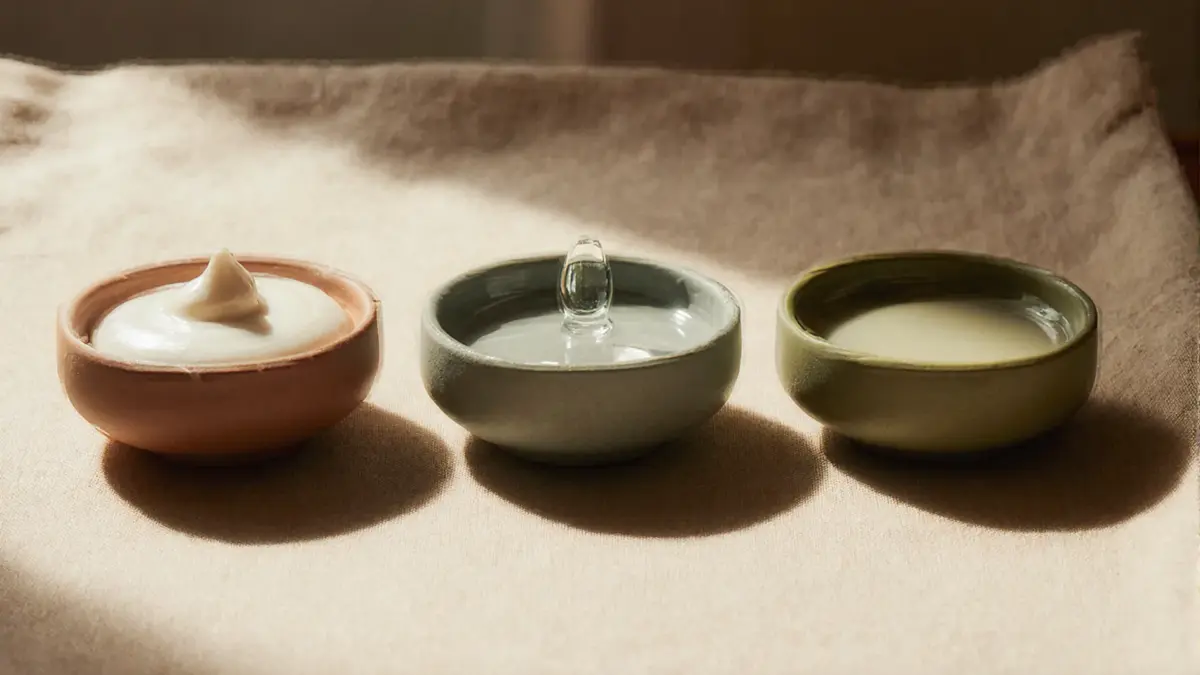
Cream, serum and moisturiser aren’t ranked from weakest to strongest — they’re different delivery formats built for different jobs, and “cream” isn’t automatically richer or more effective than “serum” just because the word sounds heavier. The real differences are how concentrated a formula is, how light or heavy it feels, when in a routine it’s meant to go on, and how much it’s designed to sit on the surface versus sink in. Here’s what actually separates them, format by format.
The Three Formats, in One Line Each
- Serum: lightweight, usually water- or gel-based, applied first onto slightly damp skin, built to deliver a concentrated dose of specific ingredients — often humectants — close to the surface.
- Moisturiser: the routine’s everyday finishing step, balancing hydration with a light occlusive layer, light enough to sit comfortably under makeup or SPF.
- Cream: typically richer and heavier than a moisturiser, usually reserved for night-time or very dry, cold conditions, built to sit on the surface longer and slow moisture loss more.
What a Barrier Serum Is Actually For
A serum’s job is concentrated delivery, not heavy sealing. It’s usually a thin, watery or gel texture in a dropper format, applied first after cleansing while skin is still slightly damp, and built around humectants — ingredients like hyaluronic acid, sodium PCA or glycerin that draw water to the skin’s surface. Because it’s the first hydrating step rather than the last, a serum is meant to be followed by something else that helps hold that hydration in, not used alone as a finishing step.
Our own Barrier Serum is exactly that: a dropper serum built on sodium PCA and hyaluronic acid at two different molecular weights, designed to help form a moisture-locking layer at the surface and support skin’s natural plumpness. It’s lightweight, absorbs in under a minute with no sticky finish, and the routine is two to three drops on slightly damp skin after cleansing, followed by a moisturiser while skin is still a little damp. It contains fragrance (listed openly as Parfum in the INCI), so it isn’t the right pick if you’re avoiding fragrance specifically. We’ve written the fuller explanation of what a barrier serum is — and isn’t — built to do, separately.
What a Barrier Moisturiser Is Actually For
A moisturiser is the everyday finishing step: light enough to wear under makeup or sunscreen, morning or night, balancing hydration with a modest occlusive layer that helps keep water from evaporating over the course of a day. It isn’t trying to deliver a concentrated dose of one ingredient the way a serum does, and it isn’t trying to seal the surface as heavily as a night cream does — it’s built to be worn constantly without feeling like a step you notice.
Our Sensitive Skin Moisturiser is fragrance-free by design and formulated to help calm redness-prone skin, in a 50ml airless pump. It’s light, not greasy, and sinks in fully within a couple of minutes with no fragrance and no warming or tingling sensation — one to two pumps, pressed evenly over the face and neck as the final step, morning or night. It’s built on sodium PCA, aloe juice, jojoba oil and hyaluronic acid.
What a Barrier Cream Is Actually For
A cream is the heaviest of the three: more emollient content, a slower, more deliberate sink-in, and a job that’s specifically about sitting on the surface and reducing moisture loss more aggressively than a lighter moisturiser would. That’s exactly why creams are so often positioned as a night-only or cold-season step — during sleep, or in a dry winter climate, skin isn’t touching fabric, makeup or a dozen other surfaces the way it does during a normal day, so a richer, slower-absorbing texture stops being a practical downside.
Our Sensitive Skin Overnight Cream is a richer, sleep-only version of the same fragrance-free, redness-calming approach: formulated to hydrate intensively overnight, noticeably richer than the daytime moisturiser but still sinking in rather than sitting on top of skin, with no fragrance and no tingling. Applied each evening as the final step, it’s built on the same sodium PCA, aloe juice, jojoba oil and hyaluronic acid base as the daytime moisturiser, with mango seed butter added for richness.
“Barrier Cream” Can Mean Two Different Things
The phrase does double duty, and it’s worth knowing which one you mean. In a skincare context — which is what the rest of this article covers — a barrier cream is simply the richest, most occlusive step in a hydration routine: the one built to sit on the surface and reduce moisture loss more than a lighter moisturiser. In an occupational or clinical context — nursing, food handling, cold-weather outdoor work, nappy care — “barrier cream” means something more literal: a thick, often zinc-oxide- or petrolatum-based product used to put a physical layer between skin and something abrasive, wet or irritating, rather than a hydration step in a skincare routine. If that’s the specific problem you’re trying to solve, that’s a different product category entirely from anything in this piece, and worth not confusing with a skincare brand’s “barrier cream.”
Layering Order: Serum, Then Moisturiser or Cream
The usual sequence is cleanse, then serum onto slightly damp skin, then a moisturiser or cream as the final sealing step. Cream and moisturiser generally aren’t both used at the same time in the same spot in a routine — a cream is more often the night-time alternative to a daytime moisturiser than an extra layer on top of it, since a routine rarely needs two different occlusive steps stacked back to back. A common, entirely reasonable pattern is: serum plus a lighter moisturiser in the morning, and the same serum plus a richer cream at night — not because the evening skin needs “more,” but because there’s no makeup or daytime activity to work around after dark.
Do You Need All Three?
Most people don’t need all three at once. A moisturiser alone, used consistently, is a complete routine for a lot of skin most of the year. A serum earns its place when skin needs more hydration than a moisturiser alone is giving it, or when skin is regularly exposed to actives (exfoliants, retinoids) that call for extra support at the hydration step. A cream tends to earn its place seasonally — a dry winter, a change in climate, skin that specifically feels tight or under-hydrated after the ordinary moisturiser — rather than being a permanent upgrade everyone eventually needs. If you’re trying to work out whether skin needs any of these three right now, the actual signs are a more useful starting point than the labels — we’ve covered the specific ones worth checking for separately.
How to Tell Them Apart When Shopping
The word on the front of a bottle is marketing, not a regulated category — a “cream” with a thin, runny texture and a “serum” with a thick, occlusive one both exist on shelves, because none of these words are standardised the way an SPF number is. The ingredient list tells you more than the format name does. We’ve written up exactly what’s worth checking on a label instead of the front-of-bottle name.
What None of These Formats Can Do
None of these three formats — cream, serum or moisturiser, from any brand — can be honestly claimed to repair a damaged skin barrier; that’s not a claim a cosmetic product is entitled to make, and it isn’t a claim we make about any of ours. What all three can genuinely do is support comfortable, well-hydrated skin while skin’s own renewal process — the thing that actually rebuilds the barrier over time — runs its course. That’s a real, useful, supporting role, just a meaningfully different one from fixing something outright. We’ve written separately about what that underlying process actually is.
Fragrance and Sensitive Skin, Across All Three Formats
Fragrance can appear in a cream, a serum or a moisturiser alike — it isn’t unique to any one format, and it’s one of the most commonly overlooked triggers when skin is already reactive. “Fragrance-free” and “unscented” aren’t the same thing either, which trips people up more often than the format question does. We’ve untangled that distinction separately, and if fragrance sensitivity is a wider concern, here’s the fuller picture of what triggers reactive skin beyond it.
FAQ
What’s the difference between a serum and a moisturiser?
A serum is a concentrated, lightweight first step, usually applied to damp skin to deliver specific ingredients close to the surface. A moisturiser is the everyday finishing step that seals hydration in and is light enough for daily wear under makeup or SPF. They’re designed to be used together, not as alternatives to each other.
Is a barrier cream just a heavier moisturiser?
In a skincare context, essentially yes — a cream sits further along the same spectrum as a moisturiser, with more emollient content and a slower sink-in, usually reserved for night-time or colder conditions where a heavier texture isn’t a practical downside.
Do I need a serum if I already use a moisturiser?
Not necessarily. A moisturiser alone is a complete routine for a lot of skin. A serum is worth adding if a moisturiser alone isn’t giving skin enough hydration, or skin is regularly exposed to actives that call for extra support underneath it.
Can I use a barrier cream in the morning?
You can, but most people find a lighter moisturiser more practical under makeup or sunscreen during the day, saving the richer cream texture for night, when there’s nothing to layer over it.
Does a thicker product do more for the skin barrier?
Not in a strength sense — a thicker texture means more occlusion and a slower sink-in, not a bigger effect on the barrier itself. Texture is a formulation choice suited to a time of day or climate, not a ranking of how well something works.