
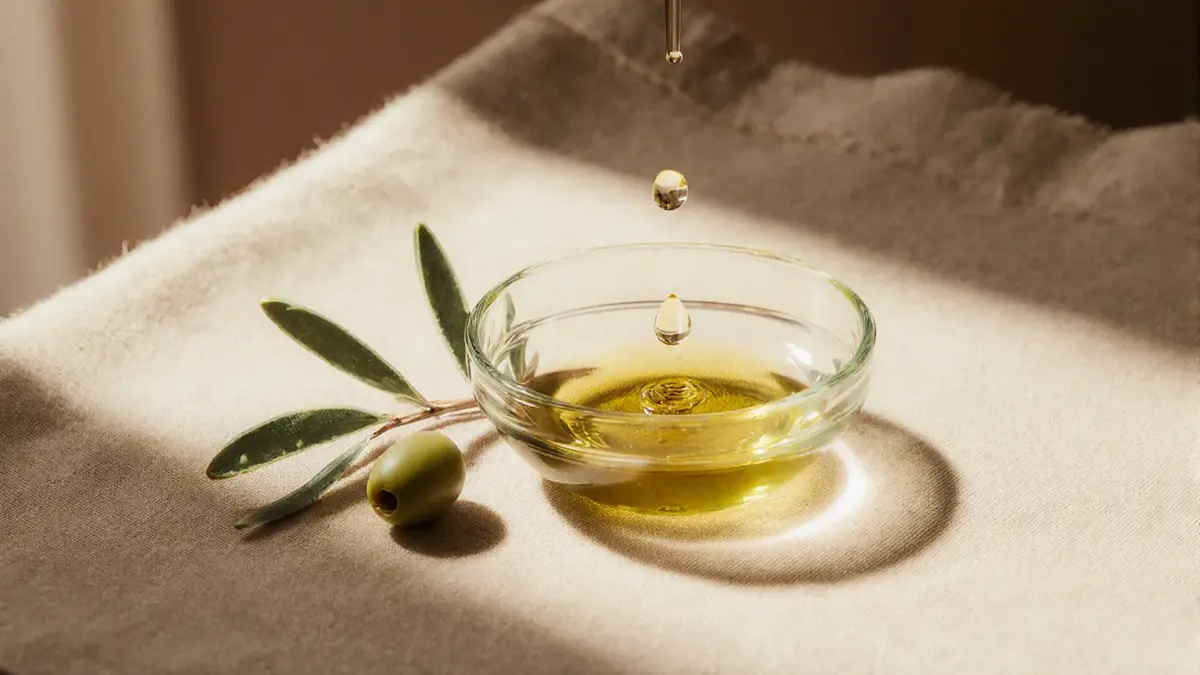
Squalane is the stable, saturated version of squalene: the same basic molecule with its chemical double bonds hydrogenated away, which stops it turning rancid in a bottle the way squalene does. Squalene is made naturally by your skin, and used to be sourced commercially from shark liver oil. The squalane in skincare today is almost always made from olive oil or fermented sugarcane instead. The two are related, but only one belongs in a product that has to survive a year on a shelf.
Squalane vs squalene: where the words come from
Squalene was first isolated in 1906 from shark liver oil, and the name comes from Squalidae, the shark family. Sharks store unusually large amounts of it in their livers, which made them the first practical source once cosmetic chemists identified the molecule.
Human skin also makes its own squalene, as part of sebum. That’s part of why it caught skincare’s attention in the first place. Squalane, one letter different, is what you get when you saturate squalene by adding hydrogen across its six carbon-carbon double bonds until none are left. That step was worked out by 1950, specifically to solve a shelf-life problem.
Shark-liver squalene was the main commercial source for much of the twentieth century. It’s no hidden footnote; it’s the reason the word exists at all. It fell out of use in cosmetics for predictable reasons: sourcing depends on deep-sea shark populations under conservation pressure, and raw squalene is chemically unstable to begin with.
The industry moved first to hydrogenating it into squalane, then to sourcing that squalane from plants entirely. Today, cosmetic-grade squalane is typically pressed from olive oil by-products or made by fermenting sugarcane with engineered yeast. Once refined, both routes give a chemically identical, fully saturated squalane.
Stability is the whole reason squalane exists
Squalene’s six double bonds are reactive sites. Oxygen in the air can attack them over time, breaking the molecule down into compounds that can irritate skin rather than help it. That’s a real problem for a product that sits at room temperature for a year and meets fresh air every time it’s opened.
Squalane has no double bonds left to react, so it doesn’t oxidise the same way and lasts far longer on a shelf. The trade-off is that squalene’s reactive structure gives it some antioxidant behaviour of its own, which inert squalane doesn’t have. In a finished product, stability generally wins. An ingredient that has degraded in the bottle isn’t doing much for skin by the time you apply it.
Who it suits, and where it sits in a routine
Squalane is an emollient. It doesn’t attract or hold water the way a humectant does. It sits between skin cells and on the surface, softening rough texture and slowing water loss, without the greasy weight some plant oils carry.
Because it’s structurally close to a lipid skin already produces, it’s well tolerated across skin types, including oily and blemish-prone skin, where heavier plant oils can feel like too much. None of our own formulas are built around it. Where we lean on an emollient, it’s usually a different one on the label: jojoba seed oil and mango seed butter do that job in our Sensitive Skin Moisturiser.
Since it isn’t drawing water in from anywhere, it doesn’t need damp skin the way hyaluronic acid or glycerin does. It’s usually one of the last steps, after any water-based serums, because its role is sealing. A few drops pressed over a moisturiser slow how quickly everything underneath evaporates. It layers easily under sunscreen and make-up in most formulations, though how a product finishes depends on everything else in it.
Once refined to cosmetic grade, the source plant stops mattering chemically. Olive-derived and sugarcane-derived squalane are the same finished molecule, and the difference shows up in sustainability claims, not in anything your skin can tell apart.
Olive-derived squalane depends on olive oil production and can take a large amount of olives per litre, while sugarcane fermentation scales more independently of a food crop’s harvest. Certification bodies like COSMOS and ECOCERT assess sourcing standards like these (see our explainer on COSMOS Organic vs COSMOS Natural), and a certification tells you more than which plant the squalane is credited to.
Quick questions
- Does modern squalane come from sharks? Essentially never in current cosmetic products. The industry moved to olive- and sugarcane-derived squalane decades ago.
- Is squalane comedogenic? It’s generally well tolerated across skin types, including oily skin, though how any single formula behaves depends on everything else blended in with it.
If a label just says “squalane” with no source named, that’s no red flag. Plant-derived squalane has been the standard for long enough that it’s the safe assumption. If sourcing matters to you, the word to watch for is “squalene”, with an E.