
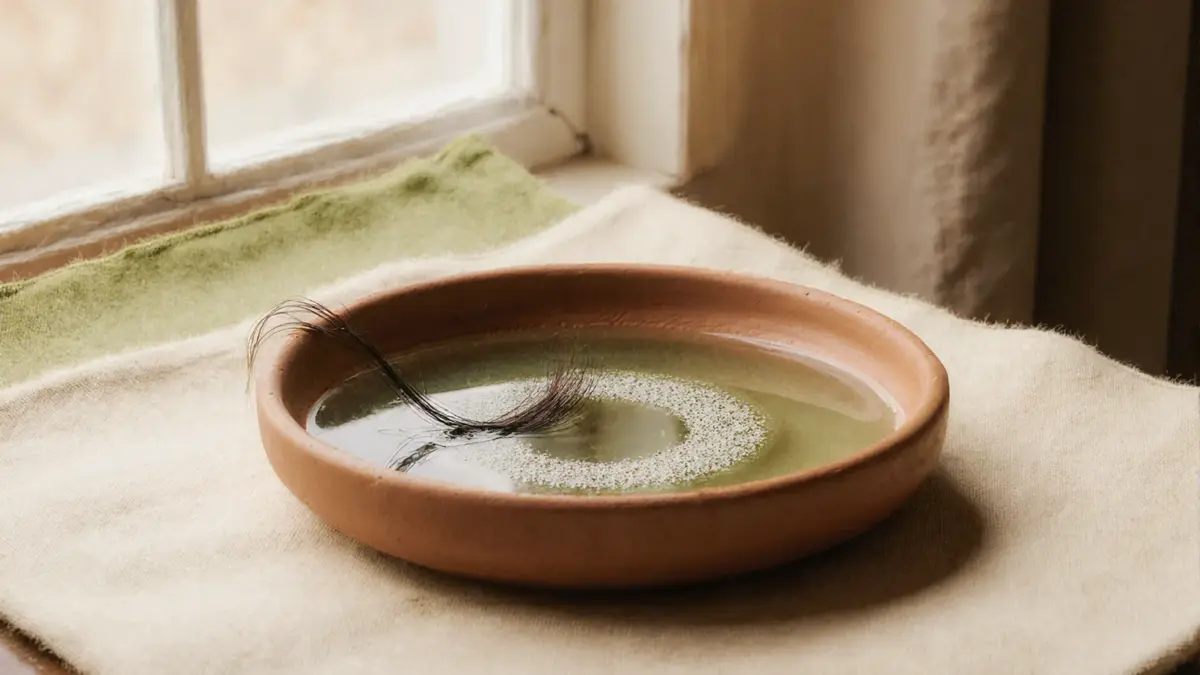
If your skin feels tight and slightly filmy right after washing, and your hair feels coated or won’t lather whichever shampoo you try, suspect the water before the products. Hard water carries more dissolved calcium and magnesium than soft water. That changes how soap and surfactants behave on contact, and the effect is chemical, not imagined.
What makes water “hard”, and what it does to soap
Water hardness measures dissolved calcium and magnesium, picked up as water passes through limestone and chalk on its way to the tap. It’s given in mg/L of calcium carbonate equivalent: roughly under 60 is soft, 61–120 moderately hard, 121–180 hard, and above 180 very hard.
It varies by region, mostly because of local geology. It’s a measure of mineral content, not cleanliness. Hard water is entirely safe to drink and wash with; it’s just chemically different to work with.
Soap and many surfactants work by binding to water and oil at once, which lets them lift dirt away and rinse off. Calcium and magnesium ions get in the way. They react with the surfactant and form an insoluble compound, soap scum, instead of a clean, rinseable lather.
That’s the pale, waxy film on a shower door in a hard-water area. The same reaction happens on your skin and hair during a wash.
What hard water does to skin and hair
That residue doesn’t just sit on the surface. Research on this mechanism has found that a substantial proportion of soap’s fatty acid residue can stay in the outermost layer of skin after washing in hard tap water. In soft or ultra-pure water, it rinses away far more completely.
The result is a filmy layer you don’t always notice, and it can push people to use more soap or cleanser to compensate, stripping more of the skin’s own oil. Population-level research has also found a measurable association between water hardness and dry skin, with calcium content specifically linked to higher odds of eczema-type symptoms in the areas studied. That doesn’t mean hard water causes eczema on its own, since skin condition has many contributing factors. But the association is real, and it’s specific to calcium.
The same mineral-surfactant reaction happens on hair, and it builds up over repeated washes rather than showing after one. Studies comparing hair washed in very hard water with hair washed in deionised water found a more abrasive surface, more mineral deposits under the microscope, and measurably lower strength, with more breakage under stress testing.
That matches what people notice without knowing why: hair that feels coated straight after washing, dulls faster between washes and tangles more, even when the shampoo hasn’t changed. For the other side of the equation, see our piece on how humectants like glycerin and sodium PCA behave on hair.
Does switching shampoo fix it?
Not reliably on its own. The reaction is between the minerals in the water and the surfactant, and a different formula can’t take the minerals out. Chelating ingredients, which bind metal ions and stop them reacting, can help within a formula, but no shampoo changes what comes out of the tap. If your hair feels coated whichever product you use, test the water before buying the next bottle.
Formula still matters, though. Gentler, lower-foam surfactant systems react with hard-water minerals somewhat less aggressively than harsh, high-foam ones. Our comparison of sodium coco-sulfate, SLS and SLES covers how different surfactants behave.
What helps:
- a shower-head or point-of-use water softener, which removes calcium and magnesium before the water reaches you
- a final cool-water rinse, which helps close the hair cuticle
- an occasional chelating or clarifying treatment to lift buildup that’s already there
- rinsing for longer than feels necessary, since hard-water residue comes away less completely than it would in soft water
Malta: a very hard-water case
Malta is a useful real-world example. According to the Water Services Corporation’s 2022 Annual Report, average total hardness across the islands is around 215 mg/L as calcium carbonate, solidly “very hard”. The supply is a blend of reverse-osmosis-treated seawater and groundwater, and it still picks up minerals through the islands’ limestone. That’s why people in hard-water regions treat softeners and descaling as standard household kit, not a niche fix.
Quick questions
- How do I know if I have hard water? Persistent soap scum on shower glass and taps, shampoo that struggles to lather, and a filmy residue on skin after washing are the practical signs. Local water suppliers usually publish an official hardness figure in mg/L CaCO₃.
- Will a different shampoo fix hard-water hair on its own? Not completely, because the reaction is between the water’s minerals and the surfactant. Gentler formulas and occasional clarifying treatments help manage the buildup. A water softener deals with the cause.