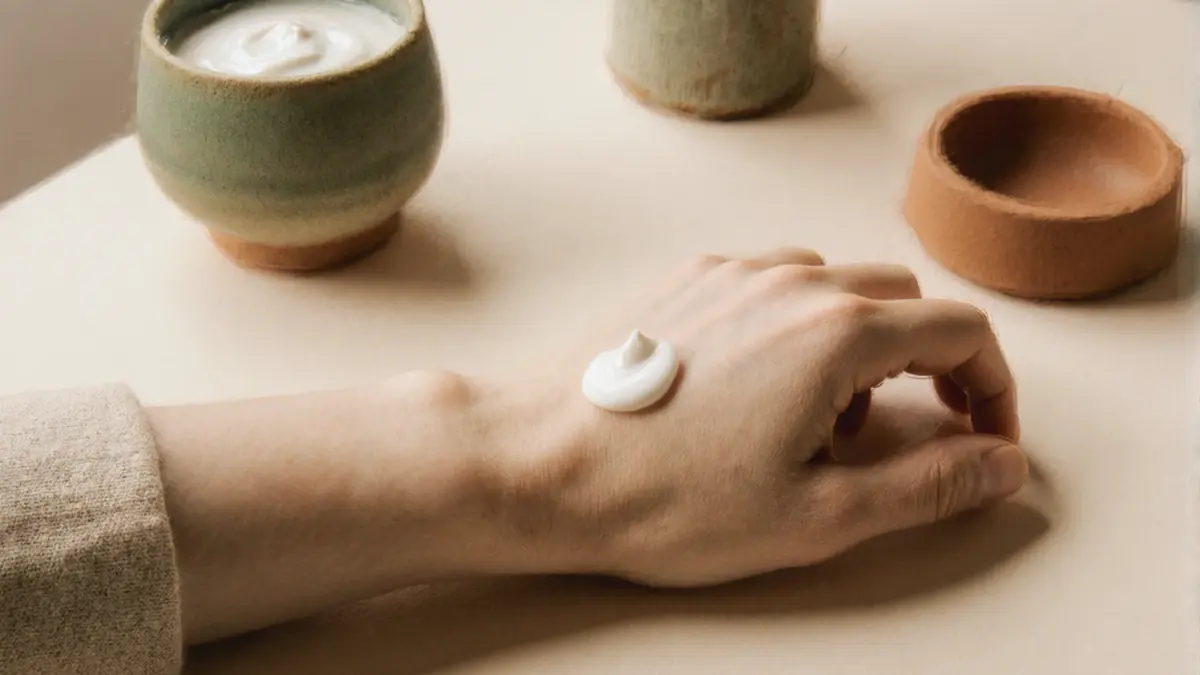
You have bought something new, and somewhere on the box there is a line telling you to patch test first. Then nothing. No mention of where, how much, how long, how many times, or what you are actually looking for. It is the most commonly given piece of skincare advice that almost nobody explains.
So here is the explanation. Done properly it takes about ten days of very little effort, and it meaningfully lowers the odds of putting something on your whole face that your skin turns out to dislike. It does not lower those odds to zero, and we will be specific about the limits.
Before anything else: when to stop and speak to someone
This goes at the top rather than in small print at the bottom, because it matters more than everything below it.
Stop using the product and speak to a pharmacist or a doctor if you get:
- Swelling, particularly of the eyelids, lips, face, mouth or throat
- Blistering, weeping, crusting or broken skin
- A reaction that spreads well beyond where you applied it
- Skin that is painful, rather than uncomfortable or itchy
- Anything that has not settled within a few days of stopping
Difficulty breathing, tightness in the throat or chest, or sudden widespread swelling is an emergency. Call your local emergency number or go to an emergency department. Do not wait to see whether it settles.
A pharmacist consultation is free in most of Europe and takes ten minutes. If a doctor is already managing a skin condition for you, their advice governs anything here.
You are testing for two different things
Skin objects to products in two quite different ways, and a test built for one will miss the other entirely. Almost every confused patch test starts here.
Irritation
Irritation is dose-dependent. Enough of a strong enough ingredient, left on long enough, will irritate most people, so it is not personal to you. It usually shows up fast, within minutes to a few hours, stays inside the area you applied it to, and reads as stinging or heat rather than itch. It generally settles once you stop.
Allergic sensitisation
Allergy works differently. The immune system has to learn an ingredient first, and only then responds to it, so a reaction can appear on the fifth exposure or the fiftieth, to something you had used happily for a year. It is typically delayed, commonly 24 to 72 hours after contact and sometimes later. It reads as itch more than sting, can extend past where you applied it, and using less does not reliably solve it.
Why the twenty-minute version is close to useless
Dab it inside your elbow, wait twenty minutes, and if nothing happens you are fine. That tests for immediate irritation, and only the loud kind. It cannot detect a delayed reaction, because it stops looking before one would have started.
Where to test
Most advice gives one location for everything, which is where it goes wrong.
Body, hand and hair products: the inner forearm
The soft skin a few centimetres below the elbow crease is easy to see, keep dry and leave alone. For a body lotion, hand cream, shower gel or shampoo, it is a reasonable stand-in for the skin the product will actually meet.
Face products: on or beside the face
Facial skin is thinner and more permeable than forearm skin. A product can pass a forearm test comfortably and still sting on the face, so test face-adjacent skin instead. Two good spots:
- Beside the jaw, just in front of the earlobe. Facial skin, visible in a mirror, and not somewhere you rub all day.
- Behind the ear, in the crease where the ear meets the head. Discreet and close in character to facial skin, though you will need good light to inspect it.
Either way, avoid a spot rubbed by a collar, mask, glasses or pillow, and keep to it throughout. Do not test on skin that is already sore, broken or freshly exfoliated.
How much, how long, and how many days
- How much: what you would normally use, spread thinly over an area about the size of a small coin. A thick blob is not a more sensitive test, just a mess.
- Leave-on products — serums, moisturisers, oils, sunscreens, treatments: leave it on. That is how you would use it, so that is how you test it.
- Rinse-off products — cleansers, shampoos, body washes: leave it roughly as long as it would sit on your skin in real use, a minute or two, then rinse. Leaving a cleanser on for six hours tells you what happens when you use it wrongly.
- How often: once or twice a day, to the same spot.
- How many days: seven to ten. Not one. Repeated exposure is what gives a delayed reaction the chance to show itself.
- Checking: look before each application, in daylight if you can, and again 48 hours after the last one — late reactions arrive in that final window. Compare with the matching spot on the other side; it catches mild changes better than memory does.
What counts as a reaction, and what is just how it feels
Not every sensation is a problem, and treating every one as a problem leaves you unable to use anything.
Usually nothing to act on: a brief tingle or warmth in the first minute that then fades, a light flush straight after applying, or slight tackiness as a product sets.
Reasons to stop:
- Burning or stinging still there after several minutes, or getting stronger
- Itch that builds over hours, or turns up the next day
- Redness with a defined edge, roughly matching where you applied it
- Small bumps, blisters, scaling or flaking at the site
- A site that looks worse on day three than it did on day one
If you are unsure, stop and let the skin go quiet for a week. Nothing is lost by waiting.
If you do react
- Stop applying it. Do not push on to build tolerance to something that produced a defined reaction.
- Rinse with lukewarm water. No scrubbing, no cleanser, no flannel.
- Leave the area alone, or use a plain moisturiser you have relied on for a long time. This is not the moment to introduce a soothing product you also bought last week, or to test something else.
- Write down the product and keep the ingredient list. The INCI list is the only record with any value later; a product name alone will not tell anyone what happened.
Most reactions to a cosmetic settle within a few days of stopping. The ones listed at the top of this article go to a pharmacist or doctor instead.
How to introduce a product after a clear test
- One new product at a time. Two at once, and a reaction tells you nothing about which one caused it.
- Leave a few days between introductions, long enough for a delayed reaction to have appeared.
- Start below the recommended frequency for anything active and work up. If a label says twice a week, begin with once.
- Build a routine in stages rather than all on the same evening, which is how our three-step ritual is meant to be assembled anyway.
The product where this matters most
The one to be most careful with is the AHA Peeling Concentrate: the range’s only leave-on exfoliant, built around 10% lactic acid and 1% hyaluronic acid.
Its usage guidance, exactly as written on the product page: “Apply to clean, dry skin in the evening and leave on overnight. Use one to two times a week — this is a leave-on exfoliant, not a rinse-off one. Because exfoliation increases sun sensitivity, avoid direct sun exposure after use and always use sunscreen the next day.” The same page notes that mild tingling on first use is normal for a lactic acid formula.
That last point is why acids need a different reading. A brief tingle is expected, so the question is not whether you feel anything, but whether it settles within a few minutes and whether the skin looks unchanged in the morning. Still burning after several minutes, or a spot that is red the following day, is past normal.
Test it once a week for a fortnight, matching its own guidance, rather than nightly to force an answer sooner.
This is not a dermatologist’s patch test
The same two words describe two very different things. What you have just read is a home tolerance check: does this product, used the way I would actually use it, seem to bother my skin? It is a screening step, and a useful one.
A diagnostic patch test is a clinical procedure run by a dermatologist or allergy clinic. Standardised concentrations of individual allergens are applied to the back under adhesive chambers, worn for around 48 hours, then read at removal and again a day or two later to catch delayed responses. It identifies which specific substance a person reacts to. A dab of moisturiser on your jaw cannot do that. If you keep reacting to products, or want to know which ingredient was responsible, that is a conversation with a pharmacist or doctor.
What this buys you, honestly
A patch test lowers your risk. It does not remove it. Skin that tolerates a product on the jaw can still object across a whole face, where the treated area is many times larger. Tolerance shifts with the season and with what else is in the routine, and sensitisation can develop to something used without incident for years — which no test beforehand could have predicted.
What it does do is catch a good share of the obvious mismatches before they cost you a week of an unhappy face, in exchange for a small dab and some patience. That is a good trade, and the one step no label can do for you — which is where we left things in our guide to reading a skincare label: nothing printed on a box, ours included, predicts how your skin will respond to a formula. Only your skin can tell you that, and this is how you ask it politely.